
Introduction
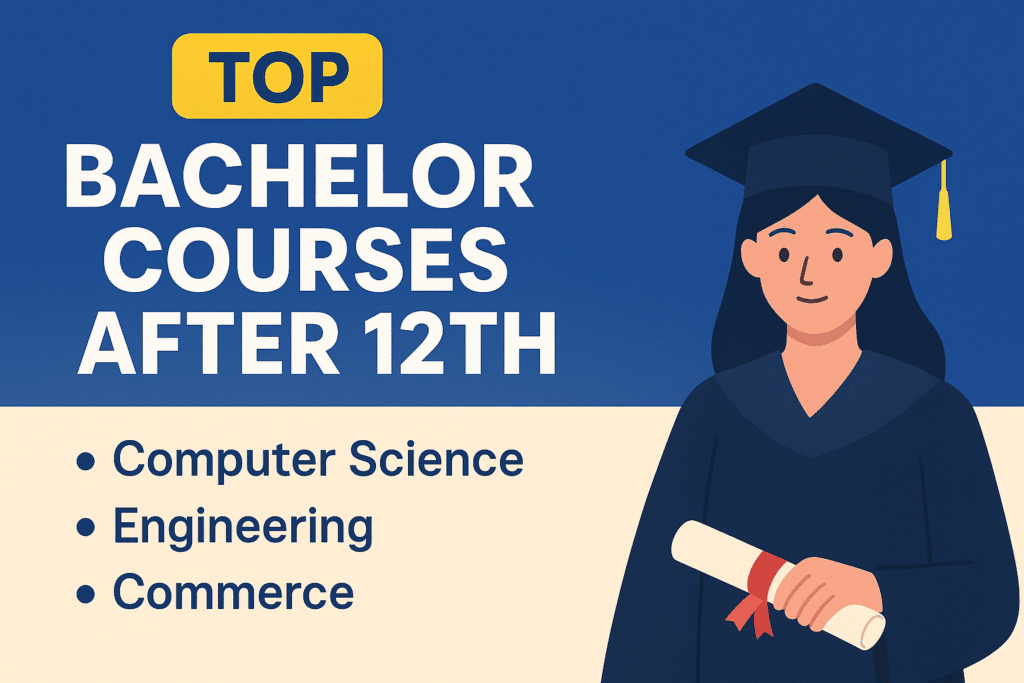
Best Bachelor Courses After 12th: Choosing the right bachelor degree after 12th is one of the most important decisions for students and parents. Whether you studied Science (Pre-Engineering / Pre-Medical), Computer Science, or Commerce in inter, the right bachelor program shapes your career, earnings, and future growth. This article lists the best bachelor courses after 12th, explains why each is valuable, and shows scope — both in India and globally — so you can pick with confidence.
Focus keyword: best bachelor courses after 12th
1. If you loved computers in 12th — Computer Science & IT routes
1.1 B.Sc. Computer Science
What it is: A 3-year degree focusing on programming, databases, algorithms, and basic software engineering.
Why choose it: Great for students who like coding, logic, and math but prefer a shorter course than engineering.
Scope: High demand globally — roles like software developer, data analyst, QA tester. Good for freelance and remote jobs. Many students go on to MSc or certifications (AWS, Azure, Data Science).
Average starting pay: India ₹3–8 LPA; international entry roles higher.
1.2 BCA (Bachelor of Computer Applications)
What it is: A 3-year professional course with focus on application development, web technologies, and programming.
Why choose it: Practical, project-based, and friendly for students without heavy math.
Scope: Strong for IT jobs, app development, and system administration. Easy path to MCA or job roles in startups and companies.
1.3 B.Tech / BE (Computer Science Engineering)
What it is: 4-year engineering degree with deep CS fundamentals, systems, networks, and advanced topics.
Why choose it: Best if you want top-tier tech roles, higher pay, and core engineering knowledge.
Scope: Highest global mobility, excellent salary (India ₹6–20 LPA starting at top firms), entry to elite MNCs, startups, and research.
2. If you liked physics & math — Traditional Engineering
2.1 B.Tech / BE (Mechanical, Civil, Electrical)
What it is: 4-year engineering degrees focused on core fields (machines, structures, power).
Why choose it: Stable jobs in manufacturing, construction, energy, and government projects.
Scope in India: Strong demand as infrastructure grows. Civil and electrical engineers are needed for smart city projects, renewable energy, and large public works. Internationally, experienced engineers get roles in oil & gas, construction, and product design.
2.2 B.Tech (Electronics & Communication / ECE)
What it is: Engineering in embedded systems, telecom, VLSI, and signal processing.
Why choose it: With IoT and 5G growth, ECE students are in demand for hardware-software roles.
Scope: Semiconductor industry, telecom companies, research labs; global job market is strong.
3. If you studied Commerce in 12th — Commerce & Business degrees
3.1 B.Com (Bachelor of Commerce)
What it is: 3-year degree in accounting, finance, taxation, and business law.
Why choose it: Entry point to CA, CMA, CS, banking jobs, and finance roles.
Scope: Good in India (banks, accounting firms), global roles in finance & bookkeeping. Pair with digital finance courses (FinTech) for better prospects.
3.2 BBA (Bachelor of Business Administration)
What it is: 3-year course on management, marketing, finance, and entrepreneurship.
Why choose it: Good for leadership, startups, sales, HR, and marketing careers.
Scope: Strong employability and easy entry to MBA later (higher pay). Internationally popular for business roles.
3.3 Specialized Degrees: BAF, BFM, BBM
Fields like Finance (BAF), Financial Markets (BFM), or Management (BBM) prepare students for niche roles in finance, stock markets, and corporate functions.
4. New-age & high-growth bachelor options
4.1 B.Sc. Data Science / B.Tech Data Science
What it is: Courses focused on data analysis, machine learning, and big data tools.
Why choose it: Data skills are in huge demand across industries — tech, banking, healthcare, retail.
Scope: Excellent global and Indian job market; remote roles and high salaries.
4.2 B.Tech Artificial Intelligence / B.Sc AI
What it is: Undergraduate training in AI models, neural networks and applied ML.
Why choose it: Strong future demand — autonomous systems, robotics, AI apps.
Scope: Top recruiters include tech MNCs and research labs globally.
4.3 B.Sc Cybersecurity / B.Tech Cybersecurity
What it is: Security engineering, network protection, and ethical hacking courses.
Why choose it: With cyber threats rising, cybersecurity experts are urgently required.
Scope: Banks, governments, IT firms hire; internationally prized skill.
5. Vocational & short-track options that work after 12th
- Diploma in Web Development / UI-UX / Digital Marketing — short, practical, fast to job market.
- Professional Certifications — AWS, Google Cloud, CCNA, CompTIA — boost employability quickly.
- Apprenticeships & internships — real experience often beats long theory for early jobs.
These are great if you want to start earning fast or test a field before a full degree.
6. How to pick the right bachelor course after 12th
Step 1: Match your interest
Pick subjects you enjoyed in inter — math & logic (CS, Engg), commerce & accounts (BCom/BBA), or practical computer work (BCA).
Step 2: Check market demand & salary
Look at job boards, LinkedIn hiring trends, and local recruiters. For example, software and cloud jobs have global demand; civil jobs are locally stable.
Step 3: Think long-term mobility
If you want to work globally, CS, Data Science, Cloud, and AI open international doors. Engineering degrees also give mobility with experience.
Step 4: Mix degrees with certifications
A B.Com + Digital Marketing cert or BSc CS + Cloud cert makes you more competitive.
Step 5: Consider cost & ROI
Private engineering colleges are expensive; a strong BCA or B.Sc + good certifications can be cost-effective and job-ready.
7. Scope & career paths after graduation
- Computer Science / AI / Data Science: Software developer → Data scientist → AI engineer → Product roles. Global remote roles and high pay.
- Engineering: Design engineer → Project manager → R&D → Consulting. Government and private sectors.
- Commerce / BBA: Accountant → Financial analyst → Banking → Business development → MBA.
- Short-term courses: Fast track to freelance or entry jobs (web dev, digital marketing, IT support).
8. Final tips for students & parents
- Start internships early (even small projects help).
- Build a portfolio (GitHub for CS, project reports for commerce).
- Learn English communication and basic tools (Excel, Google Workspace).
- Choose mentors and career counselling if unsure.
- Consider scholarships and government schemes for engineering and tech degrees.
Conclusion
Finding the best bachelor courses after 12th depends on your interests, strengths, and goals. For tech-minded students, options like BCA, B.Sc Computer Science, B.Tech CS, Data Science, and Cloud are excellent. And Engineering lovers, B.Tech in core branches remains solid. For commerce students, B.Com and BBA open clear finance & business pathways.
Start with one honest step: pick a course you can enjoy for 3–4 years, pair it with practical certificates, and take internships early. That approach gives you both confidence and strong career results — in India and internationally.