
{ Future Business Ideas in India: Future Business Ideas in India: Future Business Ideas in India }
Introduction
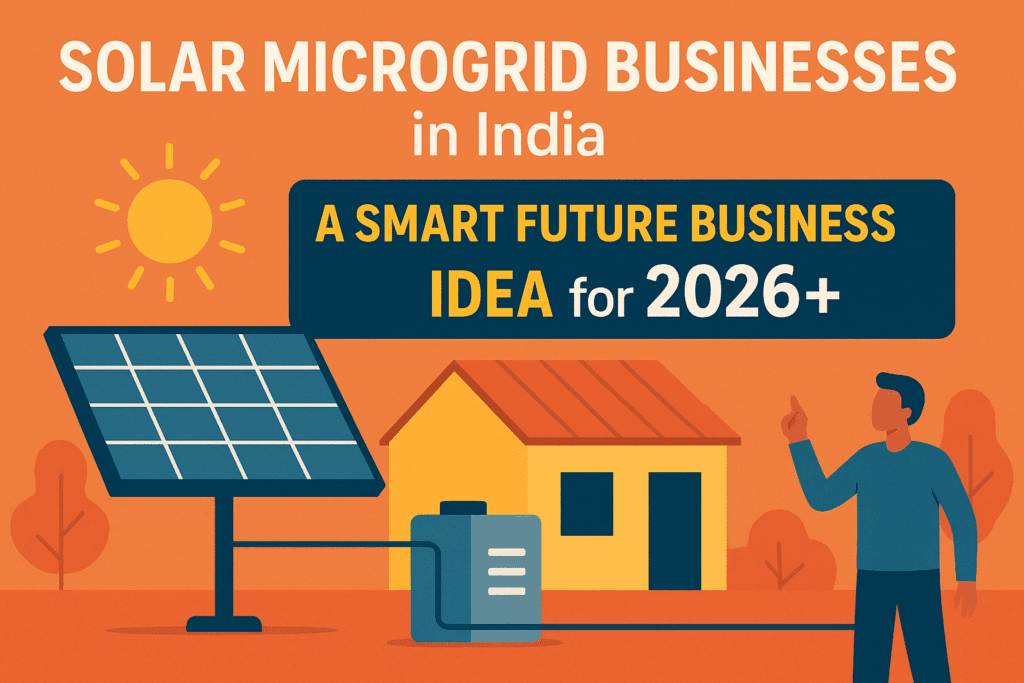
India is rapidly moving toward clean energy. For entrepreneurs, a promising and practical future business idea in India is the solar microgrid business. A solar microgrid is a local electricity network powered by solar panels — it can run on its own or connect to the main grid. Microgrids help homes, farms, factories, and remote villages get reliable power while lowering costs and cutting carbon emissions. This article explains why solar microgrids are a great business now, how to start, revenue models, and real tips to succeed.
Why solar microgrids are a top future business idea in India
1. Big demand for reliable power
Many rural and semi-urban areas still face unstable electricity. Factories and small businesses also lose money during power cuts. Solar microgrids provide steady power 24/7 when designed with batteries or hybrid systems. This real need creates a strong market opportunity.
2. Government support and schemes
India’s government supports renewable energy with subsidies, tax breaks, and programs like rooftop solar and rural electrification. These policies lower startup costs and make solar projects more profitable for businesses.
3. Falling hardware costs
Solar panels, inverters, and batteries have become cheaper and more efficient. Lower capital cost means faster payback and easier financing for new businesses.
4. Environmental and social impact
Microgrids deliver clean power and improve living standards. For social-impact investors, microgrids are attractive because they combine returns with lasting benefits for communities.
How the solar microgrid business model works
A. Basic setup
- Solar panels: Collect sunlight.
- Inverters: Convert DC to AC for use by appliances.
- Battery storage: Stores energy for night use or cloudy days.
- Control system: Manages power flows.
- Distribution network: Local wires and meters to deliver electricity.
B. Customers & market segments
- Rural households and villages (pay-as-you-go models)
- Small factories and workshops (steady commercial supply)
- Farms and cold-storage units (critical for food supply chains)
- Remote service locations (telecom towers, off-grid shops)
- Educational institutions and health clinics
C. Revenue streams
- Monthly subscription: Customers pay a steady fee for electricity access.
- Pay-as-you-go (PAYG): Metered use paid via mobile wallets.
- Service & maintenance contracts: Recurring income from upkeep.
- Government subsidies & carbon credits: Added financial support.
- Battery leasing and value-added services: Charging stations, IoT monitoring.
Step-by-step: How to start a solar microgrid venture in India
1. Market research & pilot location
Pick a location with reliable demand and poor grid quality. Talk to local leaders, check power tariffs, and estimate the number of users. A small pilot (10–50 homes or one factory) helps prove the model.
2. Business plan & financing
Create a 3–5 year plan with CAPEX, OPEX, break-even, and customer acquisition costs. Funding options include:
- Small business loans from banks or NBFCs
- Government grants and renewable energy subsidies
- Impact investors and green funds
- Crowd-funding and local partners
3. Technical design & suppliers
Choose reliable solar panels, batteries (Li-ion or flow batteries if long life is needed), and controllers. Partner with trustworthy suppliers and local installers for smoother execution.
4. Legal & regulatory checks
Get permissions from local authorities, follow electricity rules, and register any needed licenses. Seek local legal help for tariffs, net-metering (if connecting to the grid), and compliance.
5. Build the pilot & pricing
Start small. Keep pricing affordable — many successful models use a low entry fee and a monthly charge. Use mobile payments for convenience.
6. Rollout & scaling
Once the pilot proves consistent payments and uptime, scale to adjacent villages or industrial clusters. Standardize processes to lower per-site costs.
Key challenges and how to tackle them
Challenge 1: Upfront capital
Solution: Use mixed financing: equity, debt, and government subsidies. Offer battery leasing to reduce customer barriers.
Challenge 2: Technical reliability
Solution: Use quality components, remote monitoring, and local technicians for quick fixes.
Challenge 3: Customer payments
Solution: Use flexible PAYG models and mobile wallets. Build trust with community leaders.
Challenge 4: Competition and tariffs
Solution: Target niches with poor grid supply or high diesel costs. Provide bundled services (lighting + phone charging + Wi-Fi) to increase value.
Real-world examples & market signals
Several Indian startups and NGOs already run successful microgrids. These models usually begin with community pilots and scale to micro-franchises. Look for clusters where diesel gensets are expensive — there the savings from solar become clear and customers convert quickly. Urban edge areas and industrial parks are also strong candidates.
Profitability timeline & unit economics
A small microgrid for 50 households with battery backup often breaks even in 3–5 years, depending on subsidies and pricing. Key numbers to watch:
- CAPEX per kW (panels + batteries + setup)
- Average monthly revenue per user (ARPU)
- Maintenance costs and spare parts
- Customer churn and payment compliance
Using conservative estimates and local subsidies helps make the plan robust for lenders.
Tips to scale fast and safely
- Start with a strong pilot and document results.
- Use local teams to manage installations and repairs.
- Add services like cold storage or solar cold rooms for agriculture.
- Build partnerships with local government, NGOs and MSME clusters.
- Use data: monitor usage, detect faults, and optimize pricing.
Conclusion
A solar microgrid business in India fits the definition of a smart future business idea in India: it meets real demand, benefits from government support, and offers positive social impact. With the right pilot, financing plan, and local partnerships, entrepreneurs can build reliable revenue while helping communities shift to cleaner energy. If you are looking for a business with both profit and purpose, solar microgrids are one of the best ideas to explore for 2026 and beyond.
{ future business ideas in India: future business ideas in India: future business ideas in India: future business ideas in India }