

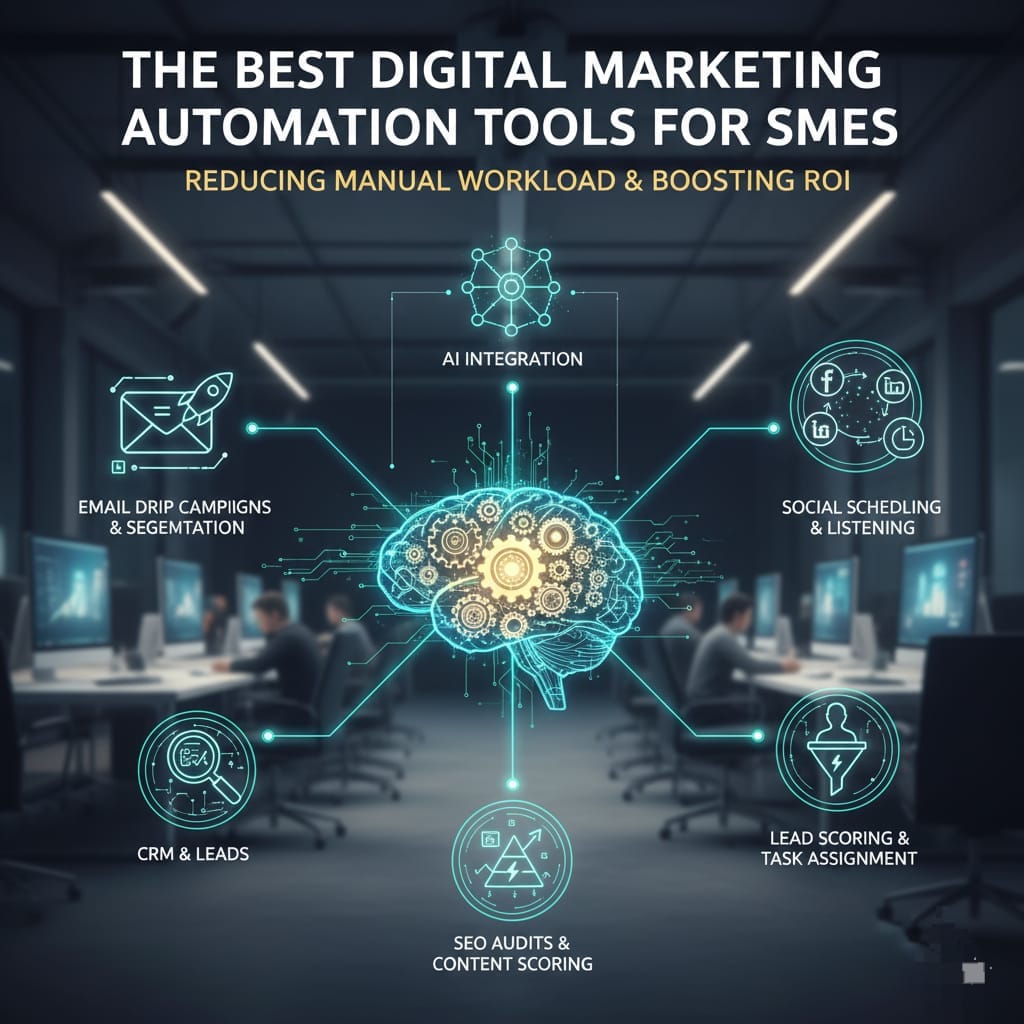
The Best Digital Marketing Automation Tools for SMEs: Reducing Manual Workload and Boosting ROI
The Best Digital Marketing Automation Tools for SMEs: A Complete Guide 2025 _ In the hyper-competitive digital landscape, relying solely on manual effort is a recipe for burnout and missed opportunities. Small and Medium Enterprises (SMEs) often struggle with limited budgets and small teams, making efficiency and automation critical for survival. The key to scalable success lies in adopting the right technologies—the Best Digital Marketing Automation Tools for SMEs—that help streamline repetitive tasks, freeing up valuable human capital for strategic thinking.
This detailed, human-written guide explores the essential technology assets that allow small businesses to compete effectively with larger enterprises by significantly reducing manual workload and focusing efforts on high-impact areas that directly boost Return on Investment (ROI).
The Automation Imperative: Why Manual Marketing Fails Today
Digital marketing today encompasses dozens of channels, from SEO and PPC to social media management and email nurturing. Attempting to manage all these manually leads to several failures:
- Inconsistency: Scheduling posts, sending emails, and tracking analytics at optimal times manually is impossible.
- Burnout: Small teams get bogged down in repetitive data entry and scheduling.
- Lack of Personalization: Manual methods cannot track and segment customer data effectively, leading to generic marketing messages that yield poor results.
Automation is not about replacing marketers; it’s about empowering them to operate at maximum efficiency.
Core Technologies to Eliminate Repetitive Tasks
The following tools are crucial technology assets that form the backbone of an efficient, low-manual-effort digital marketing strategy:
1. Email Marketing Automation: The Nurturing Machine
Email remains one of the highest ROI channels. Automation ensures messages are personalized and delivered at the perfect moment, without any manual trigger required.
Automation Focus:
- Drip Campaigns: Automatically sending a series of pre-written emails to new sign-ups over several days/weeks.
- Segmentation: Automatically categorizing subscribers based on their actions (e.g., purchased a product) and targeting them with specific content.
2. Social Media Management: Scheduling and Listening
Managing multiple social platforms manually is the biggest time sink for SMEs. Automation tools ensure a consistent, 24/7 presence and prevent missed opportunities.
Automation Focus:
- Content Scheduling: Pre-loading weeks of posts across platforms, and having the tool automatically publish them at optimal times.
- Social Listening: Monitoring mentions of your brand, industry keywords, and competitors [External Link to Trusted Social Media Industry Report].
3. SEO and Content Optimization (The Rank Booster)
SEO is highly data-driven, relying on technical analysis that no human can perform manually with speed or accuracy. Tools automate research and technical auditing.
Tools (Examples): SEMrush, Ahrefs (for research); Rank Math or Yoast (for on-page optimization).
Automation Focus:
- Site Audits: Automatically scanning your entire website for technical issues (broken links, slow loading speeds).
- Content Scoring: Giving real-time scores (like the Rank Math score) as you write, ensuring all SEO elements are included without manual checklist verification.
4. CRM and Lead Management: Organizing the Chaos
Customer Relationship Management (CRM) tools are essential for managing the journey of potential customers (leads). They automate the tracking and assignment process.
Automation Focus:
- Lead Capture & Scoring: Automatically capturing details from web forms and assigning a score based on their engagement, determining how “hot” the lead is.
- Task Assignment: Automatically assigning a high-scoring lead to a specific sales team member.
AI Integration: The Future of Automation for SMEs
The convergence of AI and Digital Marketing is the next major step in reducing manual intervention [Internal Link to your AI in Business Article]. AI tools perform tasks that go beyond simple scheduling—they handle creative and analytical work.
- Ad Spend Optimization: AI systems constantly monitor the performance of ad variations and automatically shift budget towards the highest-performing ones.
- Content Generation: AI writing assistants can generate drafts, headlines, and outlines in seconds, saving hours. The human marketer’s job transitions from writing to editing, fact-checking, and injecting human experience (E-E-A-T).
Strategic Implementation: How SMEs Reduce Workload Effectively
SMEs often make the mistake of buying too many tools. The strategic approach to integrating technology involves:
- Prioritization: Start by automating the most time-consuming and repetitive task.
- Integration: Choose tools that integrate well with each other. For example, your CRM should ideally connect seamlessly with your Email Marketing tool.
- Human Oversight: Always remember the human element. Automation handles the what and the when; the human marketer provides the why (the strategy) and the voice (the brand tone).
Conclusion: The Scalable Future of Marketing
Adopting the Best Digital Marketing Automation Tools for SMEs is no longer a competitive edge—it is a baseline requirement for survival and growth. By strategically implementing technology across email, social media, and SEO, small businesses can achieve the efficiency of a large corporation without the high operational costs. The successful marketer of tomorrow is not the one who works the hardest manually, but the one who builds the smartest system. Investing in automation today ensures that your team is focused on strategy and customer relationship building, guaranteeing a significant boost in both productivity and profit.