
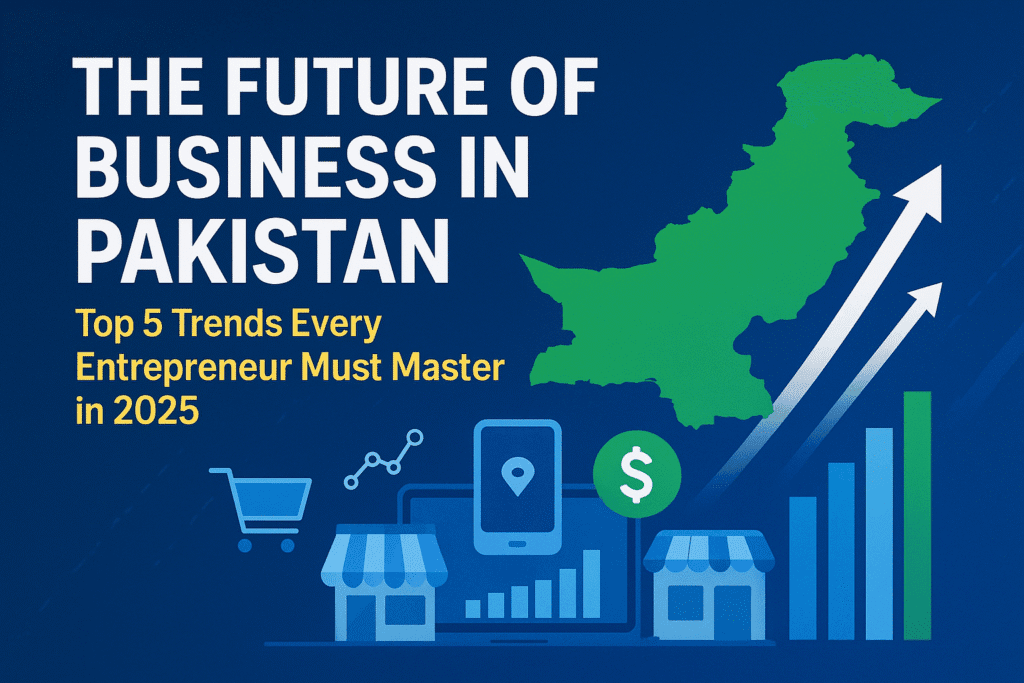
The Future of Business in Pakistan: Top 5 Trends Every Entrepreneur Must Master in 2025
The Future of Business in Pakistan: Top 5 Trends Every Entrepreneur Must Master in 2025 _ The economic landscape of Pakistan is currently undergoing a rapid transformation. While challenges persist, the nation’s young, digitally savvy population and massive potential for growth are driving significant shifts in how businesses operate. Understanding the Future of Business in Pakistan: Top 5 Trends requires mastering the key trends that are set to define market success in 2025 and beyond.
This detailed, human-written analysis of the five most crucial business trends in Pakistan offers strategic insights for new entrepreneurs and established companies aiming for sustained growth.
The Market Reality: Pakistan’s Digital Leap
Despite economic headwinds, the penetration of mobile phones and the internet continues its aggressive upward trajectory. This digital access is not just a statistical number; it is the foundational pillar supporting all modern business trends in the country. Entrepreneurs must recognise that nearly every sector—from agriculture to education—is now influenced by digital behaviour and access. Failure to adapt to this digital leap means being left behind.
Why Traditional Business Models Are Failing
Traditional, cash-based, and geographically limited business models are struggling against the flexibility and reach offered by digital platforms. High operating costs and limited market visibility are making conventional setups unsustainable. The solution lies in embracing trends that offer scalability and efficiency.
Top 5 Trends Defining the Future of Business in Pakistan
The following trends represent the most lucrative and strategically important areas for investment and innovation in the Pakistani market:
1. E-commerce and Quick Commerce (Q-Commerce) Dominance
E-commerce is no longer a luxury; it is a necessity. The rapid growth of platforms and small businesses selling via social media has proved the appetite for online purchasing.
Q-Commerce Edge: The real shift is towards Q-Commerce (Quick Commerce), focusing on ultra-fast delivery of groceries and essentials within 30–60 minutes. Businesses that invest in localised dark stores and efficient logistics infrastructure will capture this expanding market share.
2. The FinTech and Digital Payments Revolution
Pakistan remains largely an underbanked economy, with cash dominating transactions. This massive gap presents an enormous opportunity for FinTech (Financial Technology) companies.
Mobile Wallets and Micro-lending: Digital payment solutions are transitioning from simple money transfers to comprehensive digital wallets. Furthermore, AI-driven micro-lending platforms [Internal Link to your AI in Business Article] are addressing the critical need for working capital among SMEs and unbanked individuals, bypassing traditional bureaucratic bank processes.
3. EdTech: Digitalising Education and Skill Development
The need for skill development and higher education is consistently high. The EdTech (Educational Technology) sector is perfectly positioned to bridge this gap.
Online Certification and Localised Content: Companies offering certified online courses and vocational training, particularly in local languages (Urdu), are seeing explosive growth. The trend is moving towards highly interactive, gamified, and personalised learning experiences, often integrating AI tutors for immediate feedback.
4. The Vertical SaaS (Software as a Service) Wave
The Vertical SaaS trend is about creating highly specialised software for a single industry.
Sector-Specific Solutions: This involves developing management software tailored specifically for sectors like textile manufacturing, local pharmacies, or small auto-repair workshops. These solutions are designed to automate industry-specific workflows, providing a significant competitive advantage over global, generic software.
5. Green Energy and Sustainable Business Practices
Given Pakistan’s high energy costs and environmental challenges, the trend toward sustainability is an economic necessity.
Solarisation and Efficiency: Businesses are heavily investing in solar power solutions to reduce massive electricity bills. Companies offering affordable residential and commercial solar installation, battery storage, and energy management software are poised for long-term success.
Strategic Experience and Future Outlook (The Entrepreneurial Edge)
Entrepreneurs focusing on the Future of Business in Pakistan: Top 5 Trends must adopt an ‘Ecosystem First’ mindset.
Collaboration over Competition: The most successful businesses are those that partner with others. Look for synergy—a FinTech platform collaborating with a Q-Commerce delivery service, for example.
Focus on Regional Expansion: Do not limit your vision to primary cities. Tier 2 and Tier 3 cities have rapidly growing middle classes with fewer digitally accessible services. Expansion into these areas is key.
Regulatory Awareness: The regulatory landscape is constantly evolving. Staying informed and compliant with bodies like the State Bank of Pakistan (SBP) and FBR [External Link to SBP or FBR official site] is paramount to ensuring long-term trust and stability.
Conclusion: Navigating Growth and Opportunity
The Future of Business in Pakistan is defined by resilience, digital infrastructure, and a massive demographic opportunity. While economic stability may fluctuate, the underlying consumer shift towards convenience, transparency, and digital access remains constant. Entrepreneurs who successfully integrate FinTech, Vertical SaaS, and Q-Commerce solutions, while maintaining regulatory compliance and a flexible mobile-first approach, will not just survive—they will dominate the market. The biggest opportunities lie in solving the inefficiencies of the old economy with smart, scalable digital solutions.